
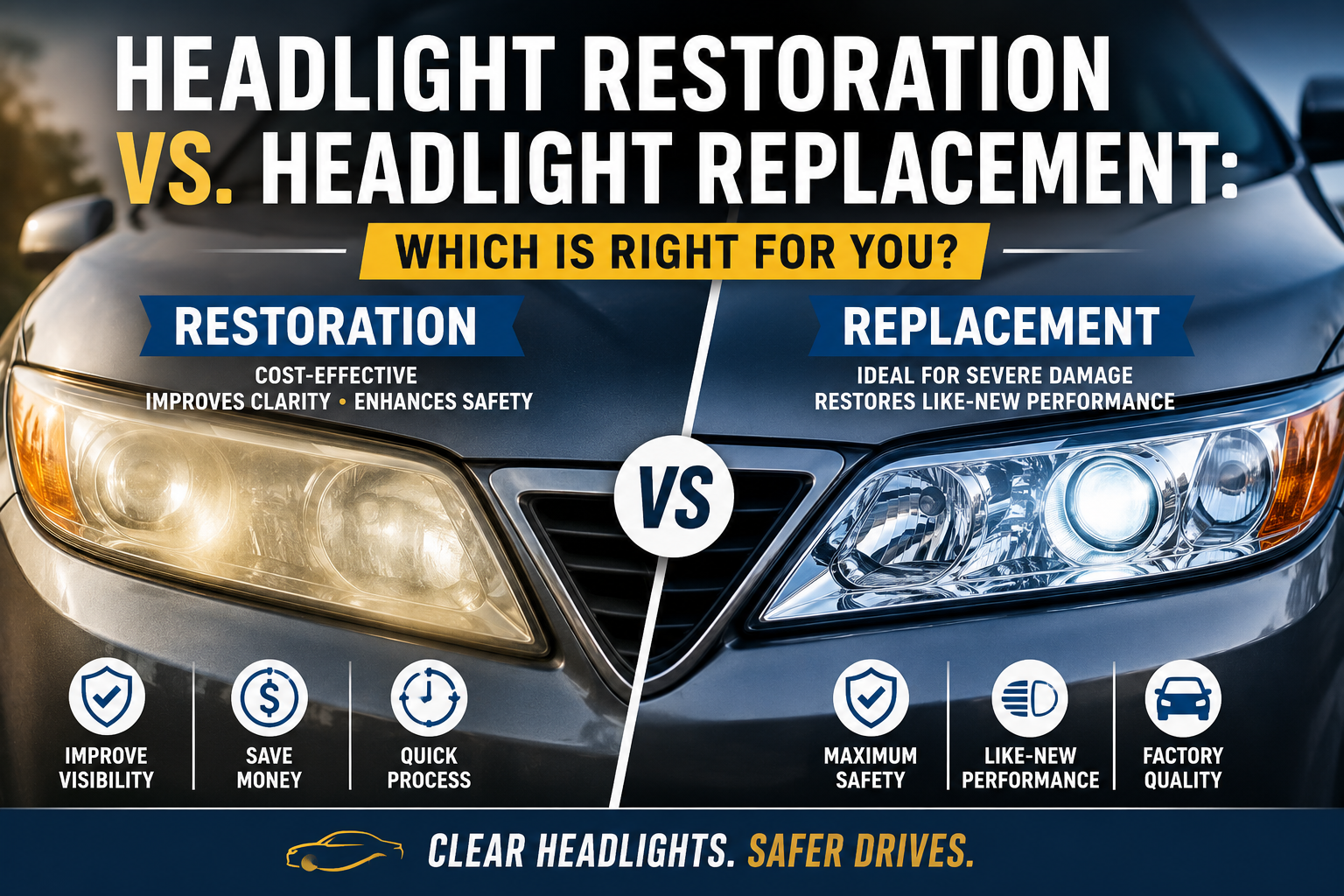
Your vehicle’s headlights are one of its most important safety features, helping you see the road clearly and making your vehicle more visible to others. Over time, however, headlight lenses can become cloudy, yellowed, scratched, or damaged due to constant exposure to sunlight, road debris, weather, and everyday driving conditions. As their condition deteriorates, so does their ability to provide adequate illumination, especially during nighttime driving or poor weather.
When headlights begin to lose their clarity or brightness, many drivers wonder whether they should choose headlight restoration vs. headlight replacement. The answer depends on the type and extent of the damage. While some headlights can be restored to improve their appearance and performance, others require complete replacement to ensure safe visibility and reliable operation.
This guide compares headlight restoration vs. headlight replacement, explains when each service is appropriate, and outlines the factors to consider before deciding which option is right for your vehicle.
The Importance of Keeping Your Headlights in Top Condition
Headlights do much more than illuminate the road ahead. They help you identify hazards, communicate your presence to other drivers, and improve overall driving confidence. Keeping them in good condition is an important part of responsible vehicle ownership.
Better Visibility at Night
Driving after sunset presents unique challenges, even on familiar roads. Reduced visibility makes it more difficult to recognize pedestrians, cyclists, animals, road signs, and unexpected obstacles.
Clear, properly functioning headlights help:
- Illuminate the road farther ahead
- Improve visibility around curves
- Increase reaction time to potential hazards
- Reduce eye strain during nighttime driving
Cloudy or oxidized headlight lenses scatter light instead of projecting it where it’s needed, making nighttime driving less safe and less comfortable.
Improved Safety in Poor Weather
Rain, fog, snow, and heavy cloud cover can significantly reduce visibility, even during the day. Under these conditions, headlights play an even greater role in helping drivers see and be seen.
Well-maintained headlights provide:
- Better visibility during heavy rain
- Improved illumination in foggy conditions
- Increased vehicle visibility to oncoming traffic
- Better recognition of lane markings and road hazards
Regular car maintenance should include checking your headlights for discoloration, reduced brightness, or visible damage to ensure they continue performing effectively in all driving conditions.
Maintaining Your Vehicle’s Appearance and Value
Headlights have a noticeable impact on your vehicle’s overall appearance. Even if the paint and body are in excellent condition, cloudy or yellowed headlights can make the entire vehicle appear older and less well-maintained.
Restoring or replacing damaged headlights can help:
- Improve your vehicle’s curb appeal
- Create a cleaner, more polished appearance
- Maintain resale value
- Demonstrate that the vehicle has been properly maintained
Because headlights are positioned prominently at the front of the vehicle, restoring their clarity is often one of the most noticeable exterior improvements a driver can make.
Difference Between Headlight Restoration and Headlight Replacement
Although both services improve visibility and appearance, they address different types of headlight damage. Understanding how each process works makes it easier to determine which solution is appropriate for your vehicle.
What Is Headlight Restoration?
Headlight restoration is a process that removes oxidation, surface scratches, and discoloration from the outer lens without replacing the entire headlight assembly.
A professional restoration typically includes:
- Cleaning the headlight lens
- Removing oxidation and yellowing
- Wet sanding to smooth surface imperfections
- Polishing the lens to restore clarity
- Applying a UV-resistant protective coating
This service is most effective when the damage is limited to the outer surface of the lens. Restoring headlights can significantly improve light output while enhancing your vehicle’s appearance at a fraction of the cost of replacement.
What Is Headlight Replacement?
Headlight replacement involves removing the damaged headlight assembly and installing a new one.
Replacement is generally recommended when the headlight has sustained damage that restoration cannot correct, such as:
- Cracked or broken lenses
- Moisture or condensation inside the housing
- Broken mounting brackets
- Internal reflector damage
- Electrical component failure
- Severe damage caused by an accident
If the damage resulted from a front-end collision, professional collision repairs may also be necessary to inspect surrounding components, verify proper alignment, and ensure the new headlight assembly fits and functions correctly.
Headlight Restoration vs. Headlight Replacement: Key Differences
Choosing between headlight restoration vs. headlight replacement isn’t simply a matter of cost. The condition of the headlight assembly, the extent of the damage, and your long-term goals all play a role in determining the best solution. Comparing the two options side by side makes it easier to understand which service offers the greatest value for your vehicle.
Cost
Cost is often the first factor drivers consider, but the least expensive option isn’t always the right one.
Headlight restoration is generally more affordable because it preserves the existing headlight assembly. Instead of replacing the entire unit, technicians restore the clarity of the lens by removing oxidation and applying a protective finish.
Headlight replacement, on the other hand, involves installing a new headlight assembly. The total cost depends on factors such as:
- Your vehicle’s make and model
- The type of headlight assembly
- LED, HID, or halogen lighting systems
- Labor required for installation
- Calibration requirements for advanced lighting systems
If the headlight itself is still structurally sound, restoration often provides excellent value. However, replacing a severely damaged assembly helps prevent recurring problems and restores the headlight to its intended performance.
Results
Both headlight services improve visibility, but the results depend on the condition of the original headlight.
Professional headlight restoration can:
- Remove yellowing and oxidation
- Restore lens clarity
- Improve light output
- Enhance your vehicle’s appearance
- Extend the life of the existing headlight assembly
Headlight replacement offers additional benefits when damage extends beyond the lens. A new assembly restores:
- Factory-level clarity
- Maximum light output
- Proper beam pattern
- Weather-tight sealing
- Like-new appearance
When performed correctly, both services contribute to safer nighttime driving by improving how effectively your headlights illuminate the road.
When Headlight Restoration Is the Better Option
Restoration is an excellent solution when the damage is limited to the outer surface of the lens.
Professional restoration is typically recommended for:
- Cloudy headlights
- Yellowed lenses
- Surface oxidation
- Minor scratches
- Light hazing caused by UV exposure
These issues develop gradually through normal use and usually don’t affect the structural integrity of the headlight housing. Choosing restoration early can improve visibility while helping you avoid the higher cost of replacing the entire assembly.
When Headlight Replacement Is the Better Option
Some types of damage cannot be corrected through restoration alone.
Replacement is usually the better choice if you notice:
- Cracked or shattered lenses
- Moisture trapped inside the housing
- Broken mounting tabs
- Burned or damaged internal reflectors
- Electrical failures
- Damage caused by a collision
In these situations, restoring only the lens won’t address the underlying problem. Installing a new headlight assembly helps ensure proper performance, durability, and safety.
If the damage occurred during an accident, it’s also important to inspect nearby components. Professional collision repairs can identify hidden damage to the bumper, fender, mounting points, or electrical wiring before the new headlight is installed, helping ensure everything functions as intended.
How to Decide Which Service Your Vehicle Needs
While the differences between restoration and replacement are clear, deciding which option is right for your vehicle isn’t always straightforward. A careful inspection of the headlights and surrounding components can help determine whether restoration will provide the desired results or if replacement is the safer, more effective solution.
Inspect the Condition of the Lens
Start by examining the headlight lenses in daylight.
If you notice:
- A cloudy or hazy appearance
- Yellow discoloration
- Minor surface scratches
- Dull or faded lenses
Professional restoration is often enough to improve both clarity and light output. However, if the headlights have:
- Deep cracks
- Broken plastic
- Large chips
- Severe impact damage
Replacement is usually the better option because structural damage cannot be corrected through polishing or refinishing.
Check Light Output
The way your headlights perform can reveal just as much as their appearance.
Signs that your headlights may no longer provide adequate illumination include:
- Dim or uneven light output
- Reduced nighttime visibility
- A scattered or unfocused beam pattern
- One headlight appearing noticeably weaker than the other
If poor visibility is caused by oxidation on the lens, restoration can often resolve the issue. However, if the problem originates inside the housing or involves damaged reflectors or electrical components, replacement may be necessary.
Consider the Age of the Headlight Assembly
Headlights naturally deteriorate over time due to constant exposure to sunlight, heat, moisture, and road debris.
As assemblies age, they may experience:
- Repeated oxidation
- Brittle plastic lenses
- Worn internal reflectors
- Failing seals that allow moisture inside
If your headlights have already undergone multiple restoration treatments or continue to develop problems shortly after being restored, replacement may provide a longer-lasting solution.
Get a Professional Vehicle Inspection
Although many headlight problems are easy to spot, others require a closer evaluation.
A professional inspection can determine:
- Whether restoration will provide satisfactory results
- If replacement is necessary
- Whether moisture has damaged internal components
- If wiring or connectors have been affected
- Whether nearby body panels or mounting points have sustained damage
This is especially important after a front-end collision. Even when a headlight appears to be the only damaged component, hidden issues may exist behind the bumper or fender. Professional collision repairs often include inspecting these areas to ensure the new or restored headlight fits securely and functions correctly.
How to Extend the Life of Your Headlights
Although no headlight lasts forever, proper care can help preserve clarity, improve visibility, and delay the need for restoration or replacement.
Wash Your Headlights Regularly
Road grime, bug residue, and environmental contaminants gradually build up on headlight lenses, reducing their clarity.
Cleaning your headlights whenever you wash your vehicle helps remove these contaminants before they become difficult to eliminate.
Apply UV Protection
Ultraviolet rays are one of the primary causes of headlight oxidation.
After professional restoration, applying a UV-resistant coating helps protect the lens from future discoloration and extends the results of the restoration.
Address Minor Damage Early
Small scratches or slight cloudiness may seem insignificant, but they often worsen over time.
Taking care of minor issues early can:
- Improve nighttime visibility
- Prevent additional lens deterioration
- Extend the lifespan of the headlight assembly
- Reduce the likelihood of requiring replacement
Including headlight inspections as part of your regular car maintenance routine makes it easier to identify these issues before they become more extensive.
Schedule Routine Inspections
Routine inspections help ensure your headlights continue performing safely throughout the life of your vehicle. During an inspection, technicians can evaluate:
- Lens clarity
- Light output
- Beam alignment
- Mounting condition
- Moisture intrusion
- Electrical connections
These checks not only improve visibility but also help identify problems that could affect overall driving safety before they become more serious.
Restore Your Headlights with the Right Solution
Choosing between headlight restoration vs. headlight replacement depends on the condition of your headlights and the type of damage they have sustained. Restoration is often the ideal solution for cloudy, yellowed, or lightly scratched lenses, while replacement is the better option for cracked housings, internal damage, or headlights affected by a collision.
If you’re unsure which service your vehicle needs, a professional inspection can help you make the right decision. Identifying the underlying cause of poor headlight performance ensures you receive the most effective solution while avoiding unnecessary repairs or replacements.
At World Auto Body & Paint Center, our experienced technicians evaluate the condition of your headlights and recommend the service that’s best suited to your vehicle. Whether you need professional headlight restoration, a complete headlight replacement, or collision repairs following an accident, our team is committed to restoring your vehicle’s safety, visibility, and appearance.
Our services also include:
- Professional car maintenance to help keep your vehicle performing at its best
- Expert car customization to enhance your vehicle’s appearance and functionality
- Vehicle inspections following accident-related damage
Schedule an appointment with World Auto Body & Paint Center today to restore clear visibility and drive with confidence, day or night.
Frequently Asked Questions
1. Is headlight restoration better than replacement?
It depends on the condition of the headlights. Restoration is ideal for oxidation, yellowing, and minor surface scratches, while replacement is recommended for cracked lenses, internal damage, or electrical issues.
2. How long does headlight restoration last?
Professional headlight restoration can last several years when the lenses are properly maintained and protected with a UV-resistant coating. Regular cleaning and routine inspections can help extend the results.
3. Can all cloudy headlights be restored?
No. Most cloudy or oxidized headlights respond well to restoration, but lenses with severe cracking, deep damage, or internal deterioration may require replacement.
4. When should headlights be replaced instead of restored?
Replacement is usually necessary when the headlight housing is cracked, moisture has entered the assembly, mounting points are broken, or internal reflectors and electrical components have been damaged.
5. How much brighter are restored headlights?
Professional restoration can significantly improve light output by removing oxidation that blocks and scatters light. The improvement depends on the condition of the original lens before restoration.
6. Can cracked headlights be repaired?
Minor cosmetic damage may sometimes be addressed, but cracked headlight housings generally require replacement to maintain proper sealing, structural integrity, and light performance.
7. Does insurance cover headlight replacement after an accident?
If the headlight was damaged in a covered collision, your insurance policy may cover replacement. Coverage depends on your policy and the circumstances of the accident.
8. How can I prevent my headlights from becoming cloudy again?
Regular washing, applying UV protection, parking in shaded areas when possible, and including headlight inspections as part of your car maintenance routine can help slow oxidation and preserve lens clarity.
9. How often should headlights be inspected?
Inspect your headlights every few months or whenever you notice reduced visibility, discoloration, or physical damage. It’s also a good idea to have them checked during routine vehicle service or after a collision.
10. Can damaged headlights affect vehicle safety?
Yes. Cloudy, cracked, or damaged headlights reduce visibility and make it harder for other drivers to see your vehicle. Prompt restoration or replacement helps maintain safe driving conditions, especially at night and during adverse weather.